
Peer-to-peer (P2P) payment applications have evolved far beyond sending quick cash to friends after dinner. Today, platforms like Cash App have successfully transitioned into comprehensive mobile financial hubs. Operated by Block, Inc., Cash App serves tens of millions of active users, offering banking, saving, investing, and tax-filing services in one unified platform.
However, because Cash App operates differently from a traditional brick-and-mortar bank, it is important to understand its structure, fees, and safety policies. This detailed review explores Cash App’s mobile banking features, account costs, pros, and cons to help you determine if it is the right financial tool for your daily needs.
Cash App at a Glance
| Feature | Details |
| Institution Type | Financial technology platform (not a bank) |
| Partner Banks | Sutton Bank & Wells Fargo, N.A. (Members FDIC) |
| Monthly Fees | $0 |
| Minimum Balance | No minimum requirements |
| Maximum Savings APY | Up to 3.25% APY with Cash App Green status |
| Extra Features | Stock & Bitcoin investing, free tax filing, child-managed accounts |
What is Cash App Banking?
It is essential to clarify that Cash App is not a bank. Instead, it is a financial technology platform that partners with chartered banks—primarily Sutton Bank and Wells Fargo, N.A.—to handle banking services and secure Federal Deposit Insurance Corporation (FDIC) protection for your funds.
If you sign up for a Cash Card (Cash App’s free, customizable Visa debit card), your balance becomes eligible for FDIC pass-through insurance of up to $250,000. Without this card, any money left in your standard balance is not protected by federal deposit insurance.
Key Banking and Financial Features
Cash App offers a highly versatile suite of everyday financial services:
Cash App Savings
Cash App provides a dedicated, fee-free savings section within the app.
- The Yield: Users can earn up to a competitive 3.25% APY on their savings balance.
- Unlocking the Highest Rate: To qualify for the 3.25% APY, you must earn “Cash App Green” status. You can achieve this by either depositing $300 or more in qualifying direct deposits monthly, or by spending at least $500 per month using your Cash Card or Cash App Pay.
- Automatic Saving Tools: You can set up automated savings by allocating a percentage of your direct deposits or by turning on “Round-ups,” which automatically rounds up your debit card purchases to the nearest dollar and transfers the difference to savings.
Managed Accounts for Kids and Teens
In a major step forward for family budgeting, Cash App offers managed accounts for children aged 6 to 12. This is in addition to their existing accounts for teens aged 13 to 17. With full parental oversight, younger users can design their own Cash Card, receive allowances, set savings goals, and earn up to 3.25% APY. To prioritize safety, these accounts restrict access to more complex features like Bitcoin and stock trading.
Pay-Over-Time P2P Transfers
Cash App allows users to convert their standard peer-to-peer money transfers into flexible installment plans. Whether you are splitting utilities with a roommate or paying back family members, this feature allows you to pay over time, giving you greater immediate control over your cash flow.
Fractional Investing
Through the “Investing” tab, Cash App allows you to purchase fractional shares of US stocks or buy Bitcoin with as little as $1. There are no commission fees for standard stock trading, making it a very accessible entry point for beginners.
Cash Card “Boosts”
The Cash Card is a free debit card linked directly to your balance. By activating the app’s “Boost” feature, you can access instant discounts at popular retailers, restaurants, and grocery stores when checking out.
Cash App Taxes
Formerly known as Credit Karma Tax, Cash App Taxes is built directly into the platform. It allows users to file both federal and state tax returns entirely for free, with zero hidden charges or filing fees, regardless of your tax situation.
How Cash App Compares to Competitors
To truly understand Cash App’s position in the market, it helps to compare it to other leading digital financial platforms:
- Cash App vs. Venmo: While Venmo is highly social and great for splitting bills, Cash App offers superior financial features, including direct stock investing, Bitcoin trading, and built-in tax filing, which Venmo lacks.
- Cash App vs. Chime: Chime acts more like a traditional checking account with standard banking features. Cash App, on the other hand, is much more of a multi-tool, combining peer-to-peer payments with saving and investing tools, though Chime offers a wider array of traditional credit-building options.
Cash App Fees Explained
While basic use of the app is completely free, certain convenience fees apply:
- Standard Transfers (Bank Deposit): Free (takes 1 to 3 business days).
- Instant Deposits: 0.5% to 1.75% of the deposit amount (minimum $0.25 fee).
- Credit Card Transactions: If you fund a P2P transfer using a linked credit card, you will be charged a 3% fee.
- ATM Withdrawals: Cash App charges a $2.50 fee for ATM withdrawals. However, if you receive at least $300 in direct deposits each month, Cash App waives this fee at in-network ATMs.
Safety, Security, and Scam Protection
Because Cash App transactions are fast and irreversible, security is a vital consideration:
- Instant Transfers are Final: Much like physical cash, once you send a payment to another user’s $Cashtag, the money is gone. Cash App cannot easily reverse transactions, meaning accidental payments or scam transfers are rarely refunded.
- Security Settings: Users should always enable security locks within the app, requiring a PIN, Face ID, or Touch ID before any transaction is authorized.
- Customer Support Limitations: Unlike traditional banks with local branches, Cash App’s customer support is primarily digital. Resolving compromised account issues can sometimes take longer than it would with a traditional brick-and-mortar bank.
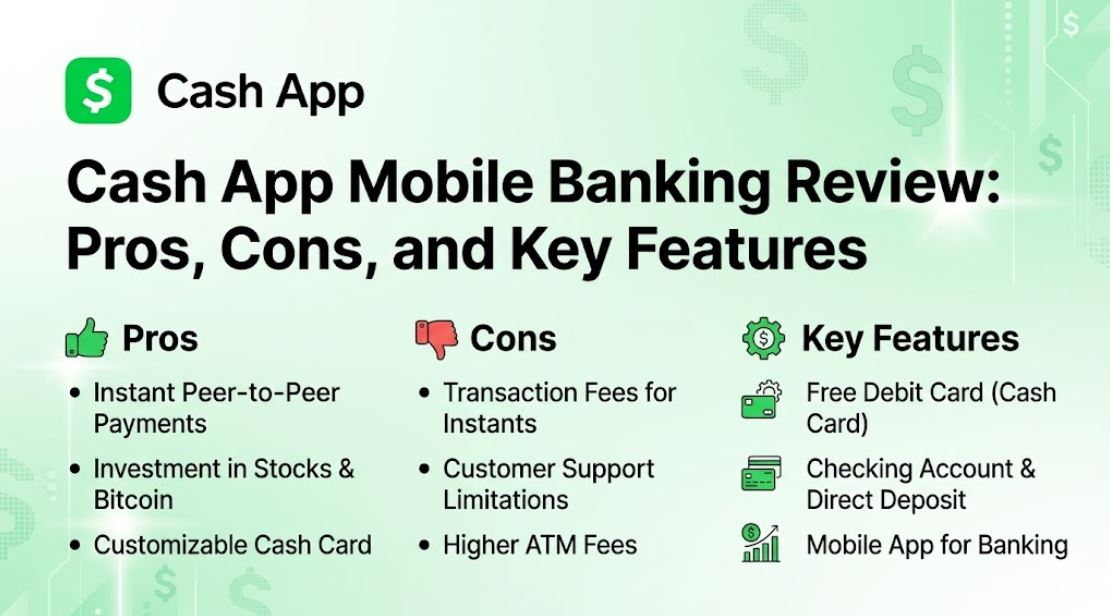
Pros and Cons of Cash App Mobile Banking
Pros:
- Zero Mandatory Fees: No monthly maintenance fees, setup costs, or minimum balance requirements.
- Highly Competitive Savings Rate: Up to 3.25% APY is easy to unlock if you set up direct deposits or actively use the Cash Card.
- Seamless All-in-One Dashboard: Move money effortlessly between P2P transfers, savings, stocks, and Bitcoin within a single app.
- Free Custom Debit Card: Custom design options, Apple/Google Pay compatibility, and immediate savings through the Boost program.
- Overdraft Protection: Free overdraft coverage up to $200 for users with Cash App Green status.
- Flexible Installments: The ability to pay back peer-to-peer payments over time.
- Free Tax Filing: Convenient, zero-cost state and federal tax preparation.
Cons:
- Not a True Bank: Your balance does not automatically carry FDIC insurance unless you actively order and maintain a Cash Card.
- P2P Transfer Finality: Transactions are instant and irreversible, making scams difficult to dispute.
- Convenience Fees Add Up: Standard transfers are free, but paying for instant bank deposits or funding transactions with a credit card can become expensive.
- No International Remittance: Cash App does not support direct international money transfers, meaning you must look to alternative services for overseas payments.
The Verdict: Is Cash App Right for Your Banking Needs?
Cash App is an exceptional secondary banking tool and an incredibly convenient wallet for everyday spending, casual investing, and peer-to-peer transfers. It is especially valuable for families who want to teach their children healthy financial habits early on through managed accounts.
However, because Cash App lacks physical branches, has limited customer dispute options for accidental P2P transfers, and does not automatically apply FDIC insurance to basic account balances, it may not completely replace a traditional, full-service bank account. For most users, it functions best when paired with a primary bank account.
Frequently Asked Questions (FAQs)
Is my money safe in Cash App?
Your money is FDIC-insured up to $250,000 only if you have successfully ordered and activated your physical Cash Card. Without the card, your general balance does not automatically carry standard federal deposit protection.
How do I get the 3.25% APY on Cash App Savings?
To earn the 3.25% APY, you must qualify for “Cash App Green”. You can do this by receiving $300 or more in direct deposits per month, or by spending $500 or more using your Cash Card in a single month.
Can I file my taxes for free using Cash App?
Yes. Cash App Taxes is a 100% free federal and state tax filing service built directly into the platform, with no hidden filing fees.
